
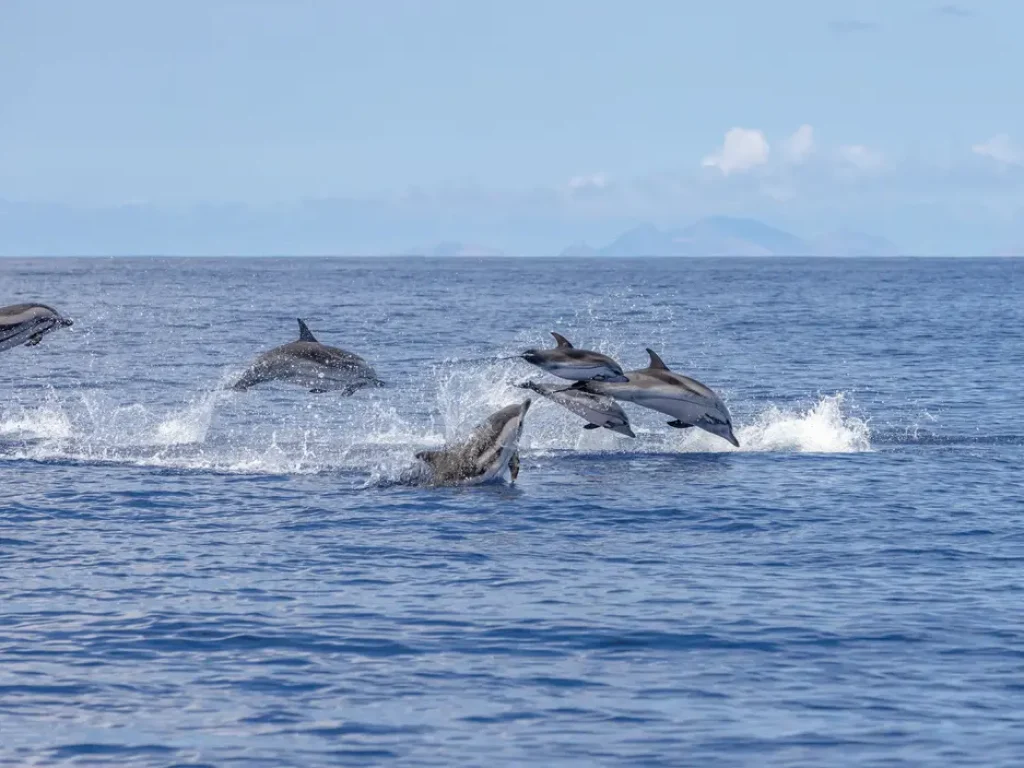
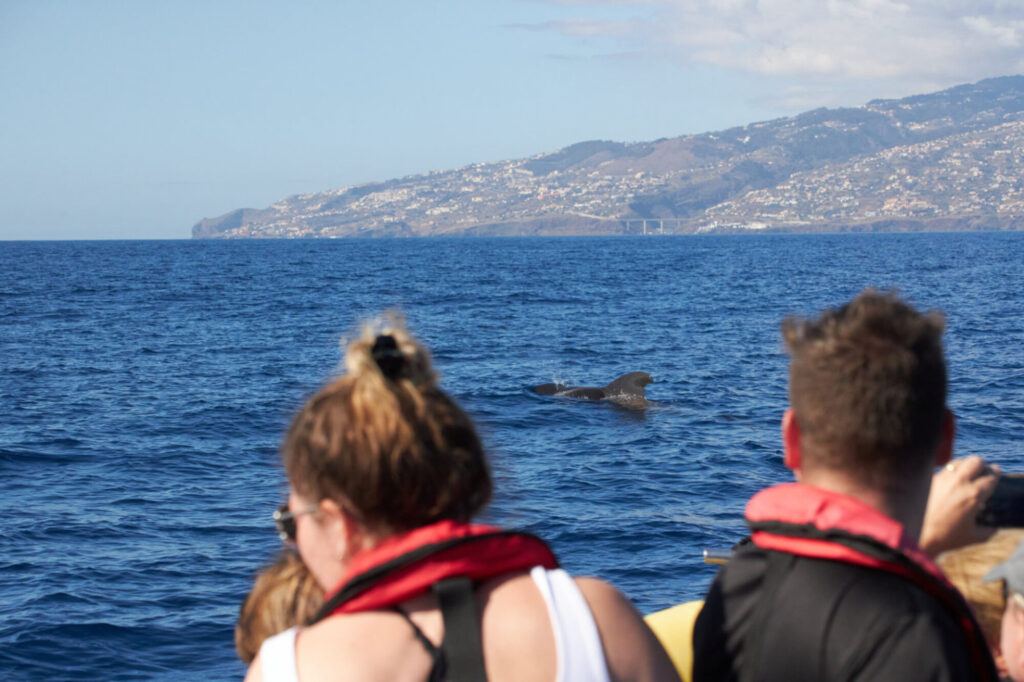
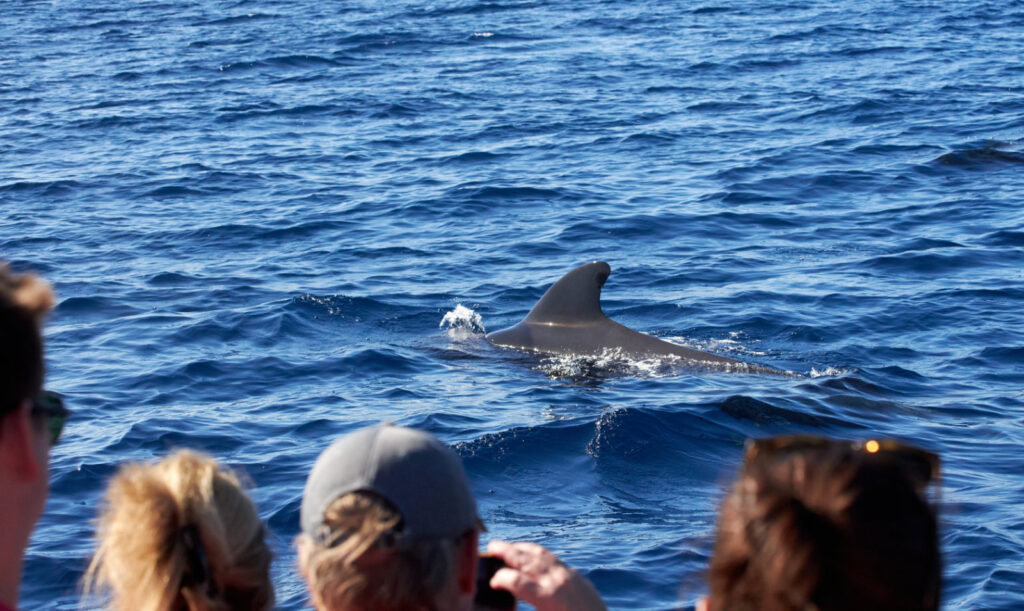
The best time for whale watching in Madeira is, unhelpfully, most of the year, and that is the genuinely useful answer. Bottlenose dolphins and short-finned pilot whales are resident here, so there is no closed season and no dead month. What actually changes through the year is which species you are likely to meet, and that is worth planning around.
Why Madeira works all year
Most coastal destinations sit on a shallow continental shelf, which pushes deep-water species far offshore and turns a whale watching trip into a long commute. Madeira has no shelf worth the name. The island is the top of a volcano, and the sea floor falls away fast. Off the south coast you are over 1,000 metres of water within about three nautical miles, and past 2,000 metres inside eight.
That steepness drives nutrient-rich water upward and supports the whole chain, from plankton to deep-diving squid hunters. It also means boats reach productive deep water shortly after leaving harbour instead of hours later, which is the only reason a half-day trip works here at all.
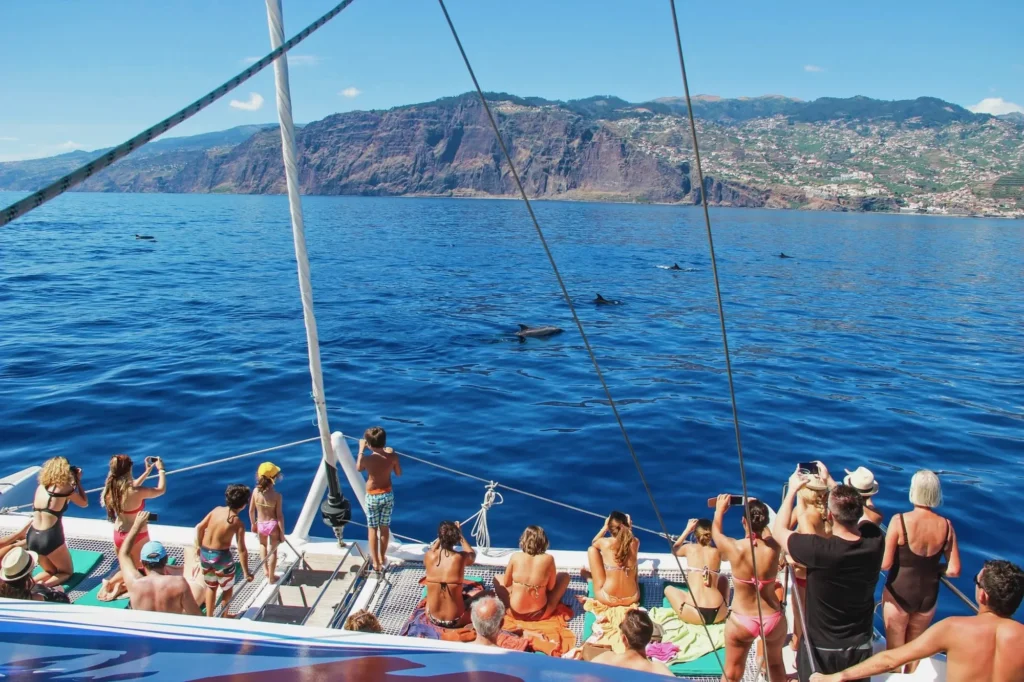
Season by season
The pattern below follows the peer-reviewed distribution modelling by Fernandez and colleagues (Frontiers in Marine Science, 2021, DOI 10.3389/fmars.2021.688248), built on more than 8,600 sightings logged by Madeiran whale watching operators between 2003 and 2018. It describes likelihood, not guarantees.
| Season | Most likely encounters | What it means for a trip |
|---|---|---|
| Spring Mar – May | Bottlenose dolphins and pilot whales (resident); short-beaked common dolphins, which run strongly from December through June; striped dolphins building toward their spring and early-summer peak; fin whales | One of the two strong windows for common dolphins, and the likeliest season for fin whales. Seas can still be unsettled. |
| Summer Jun – Aug | Bottlenose dolphins and pilot whales; Atlantic spotted dolphins; striped dolphins into early summer; sperm whales, which peak in summer and early autumn; Bryde’s whales, increasing from June | The widest mix and the calmest conditions. Also the busiest, so book ahead. |
| Autumn Sep – Nov | Bottlenose dolphins and pilot whales; Atlantic spotted dolphins; sperm whales through early autumn; Bryde’s whales | Arguably the connoisseur’s window: strong variety, fewer boats, often settled early-autumn seas. |
| Winter Dec – Feb | Bottlenose dolphins and pilot whales; short-beaked common dolphins returning in numbers; Bryde’s whales into January | Fewer species, but the residents are genuinely resident. The variable is weather, not wildlife. |
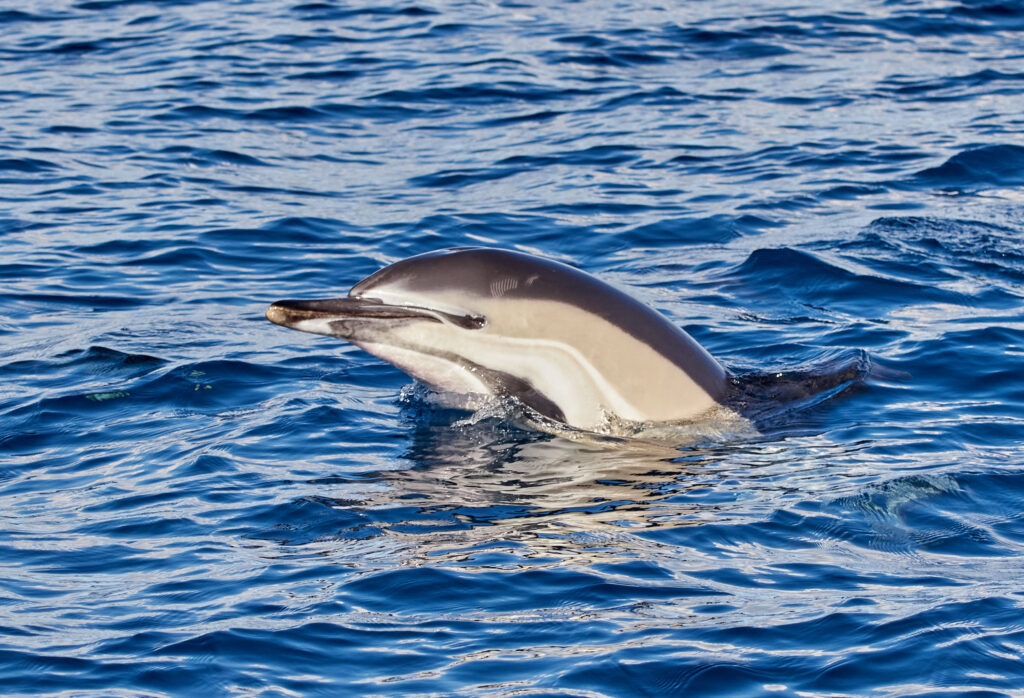
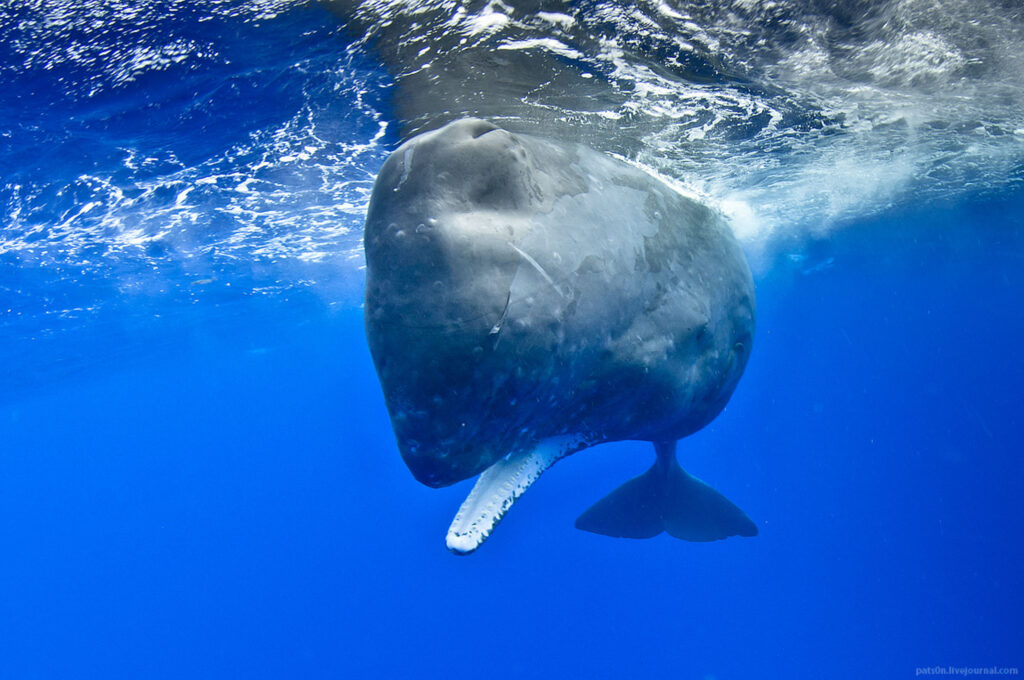

A note on the whales people actually ask about. The Bryde’s whale is the most frequently recorded baleen whale in Madeiran waters and is a summer-through-winter animal here, not a spring one. Sperm whales are present year-round rather than seasonal visitors, with the best odds in summer and early autumn. If a single stretch has to be picked, June to October combines the widest species range with the most reliable sea conditions.
Best time of day
Time of day matters less to the animals than it does to the sea. Calm water makes spotting easier, makes the ride more comfortable and makes a weather cancellation less likely, so book against the forecast rather than the clock. An early departure carries one practical advantage regardless: if it is called off for conditions, you still have the rest of the day to rebook. Late-afternoon and sunset departures trade some of that flexibility for better light.
If you are prone to seasickness, take the earliest slot available and deal with it before you board rather than once you are aboard.
The rules that shape your trip
Whale watching in Madeira is governed by regional law: Decreto Legislativo Regional n.º 15/2013/M and its regulation on observing marine vertebrates. It is worth knowing what it actually says, because it explains the shape of a good trip and because a lot of what circulates online is wrong.
- Fifty metres, not a hundred. Actively approaching closer than 50 metres to any marine mammal or pelagic seabird is prohibited, and 25 metres for sea turtles. The 100-metre mark is the outer edge of the observation zone, not a standoff distance: between 100 and 50 metres the boat counts as in observation and must keep its speed down.
- Ten minutes per boat, forty in total. A vessel may stay in the observation area for up to 10 minutes, and the total observation time across every boat present is capped at 40 minutes. That total is shared, which is why a skipper may hold off when others are already on a pod.
- Approach at an angle. Boats converge on the animals’ line of travel at roughly 30 degrees. Head-on is prohibited, so is coming straight up behind them, and so is cutting perpendicular across their path.
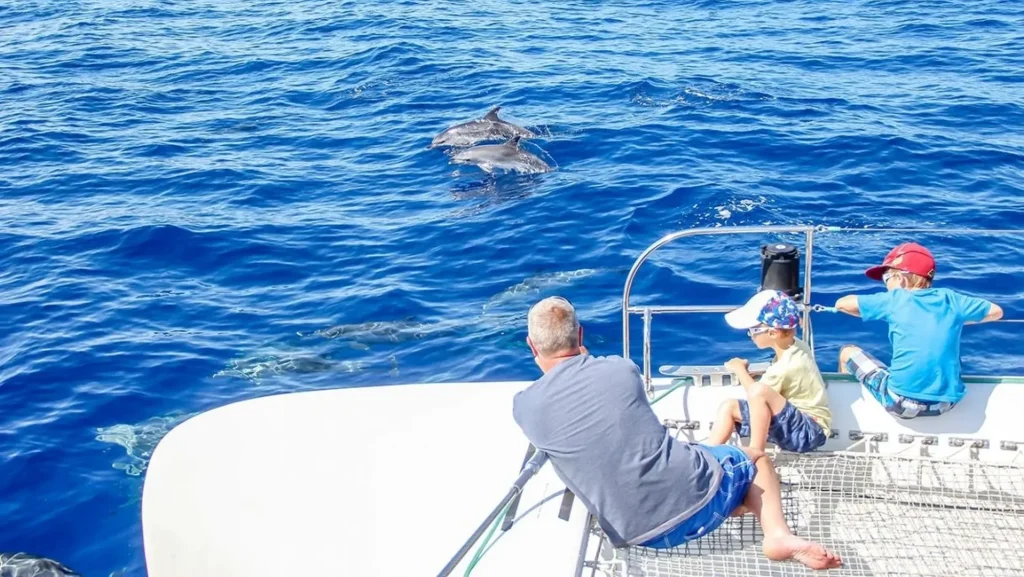
- If they come to you, hold your course. When animals approach the boat, and bow-riding is common with dolphins here, the rule is to maintain the course and speed you already had, not to stop. Cutting the engine to neutral is the rule for turtles, not for dolphins.
- Pods stay together. Breaking up a group is prohibited, and isolating a calf especially so.
These are wild animals in open water, and nobody controls where they are on a given morning. What a good operator can offer instead of certainty is a fair policy if the ocean does not cooperate: several Madeiran operators will take you out again free of charge if you see nothing at all. It is worth asking before you book.
Which trip suits which season
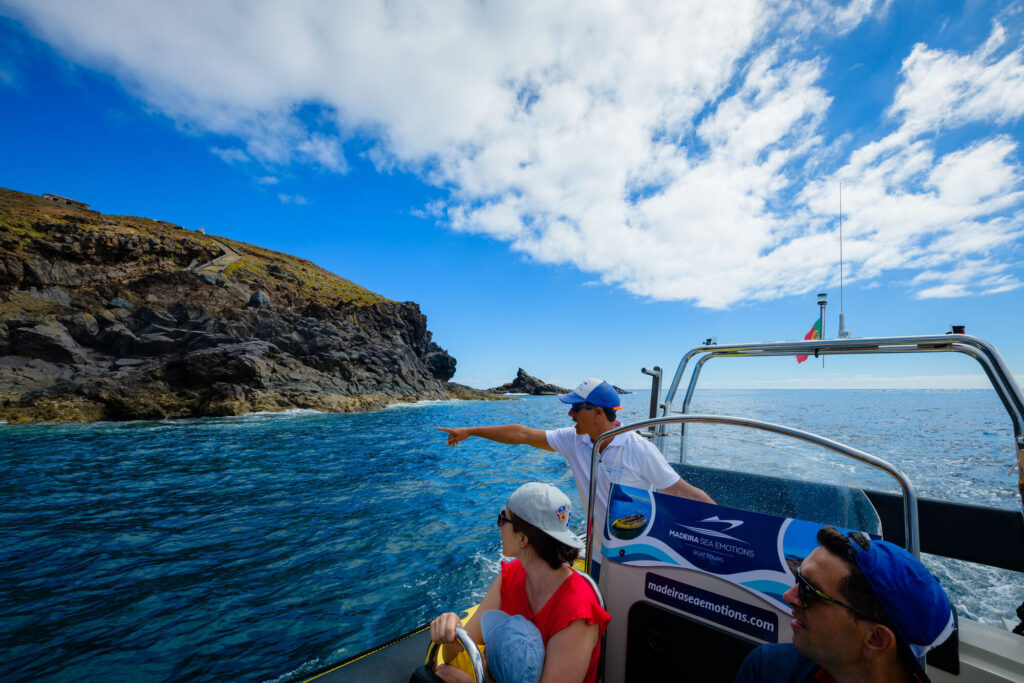
Once the dates are fixed, the remaining choice is the boat. In summer, when the sea is flat and the day is as much about being on the water as what surfaces beside it, a catamaran gives you deck space and shade. The Funchal whale watching catamaran tour is built for that, and carries a free second trip if the first draws a blank. In spring and autumn, when conditions are less settled and you would rather have manoeuvrability than deck space, the smaller, faster boat on our whale and dolphin watching trip from Quinta do Lorde is the better instrument.
Every departure sits under whale and dolphin watching in Madeira. If you are weighing this against everything else that leaves Funchal, we compare the options in the best boat trips in Madeira.
FAQ
There is no single best month, because bottlenose dolphins and short-finned pilot whales are resident year-round. For the widest range of species alongside settled seas, aim between June and October. For good variety with fewer boats, September and October are the value pick.
Yes. Trips run year-round and the resident species are still there, joined by short-beaked common dolphins, which are at their strongest from December. The limiting factor in winter is weather rather than wildlife: more departures are cancelled for sea conditions, so build a spare day into the trip.
No wild-animal encounter can be promised outright. What some operators here do offer is a guarantee of a different kind: if your trip sees nothing, you go out again free. Check the specific policy on the trip you book.
Not on a whale watching trip. The approach limits apply to the vessel, and entering the water with cetaceans is not part of a regulated watching excursion. If dolphins choose to come to the boat you will see them at close range from the deck, which is the encounter the rules exist to protect.


